Rosenfeld argues campus protests prioritized emotion over historical knowledge
A new book by Indiana University scholars claims the post-October 7 encampments were driven by ideological mobilization rather than factual debate.
By Anthony Rivera ·
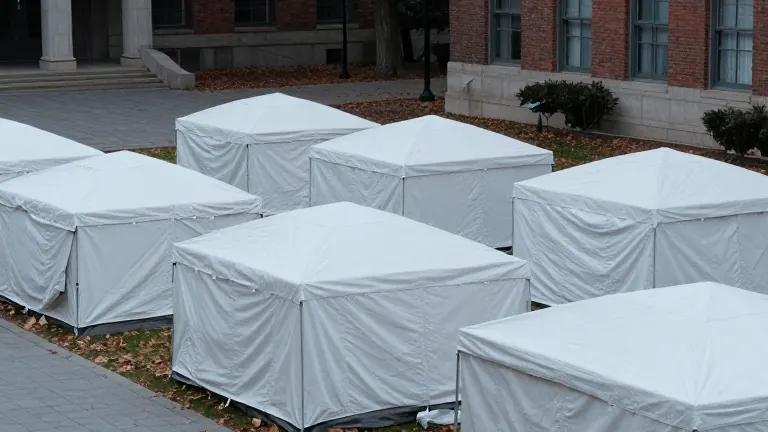
Jewish studies professor Alvin Rosenfeld argues that the anti-Israel encampments that erupted on American university campuses in 2024 were fueled by intense emotion rather than factual accuracy. In a new edited volume titled "Toward the Last Encampment: Campus Culture and the Jews Before and After October 7," Rosenfeld and other scholars contend that the movement was an exercise in ideological mobilization. The book examines the political and cultural forces behind the surge in anti-Israel activism and antisemitism following the October 7, 2023, Hamas attack.
Rosenfeld, who directs Indiana University’s Institute for the Study of Contemporary Antisemitism, described the dynamic as a conflict over feelings rather than data. He noted that participants often displayed a lack of historical knowledge despite the academic setting. During the 2024 encampments at Indiana University, Rosenfeld approached a student shouting slogans about the Second Intifada. The student could not explain that the conflict resulted in approximately 1,000 Israeli civilian deaths between 2000 and 2005, yet continued to chant without pause.
The book includes an account by Rabbi David Wolpe, who was a visiting scholar at Harvard during the initial protests. Wolpe described a moment when a Jewish student told him, "They don’t just hate what I believe. They hate me." This sentiment reflected a broader trend of hostility that university administrators struggled to manage. In the Netherlands, scholar Eliyahu Sapir documented how administrators often responded to complaints from Jewish faculty and students with abstract language that failed to provide concrete solutions.
Evidence in the book suggests that some protest activities were coordinated prior to the conflict. Rosenfeld stated that more than 30 student organizations at Harvard issued statements blaming Israel on October 7, before Israeli forces entered Gaza. Additionally, a resistance handbook was distributed nationally within 24 hours of the attack by Students for Justice in Palestine and allied faculty groups. Rosenfeld recalled being warned by a faculty member days before the attack that difficult times were approaching, a detail he now views as evidence of preparatory work.
The scale of the 2024 encampments was substantial, appearing at more than 100 American universities. At Indiana University, which has approximately 45,000 students, Rosenfeld observed that only 200 to 300 students led the anti-Israel activity. Despite their small number relative to the total population, this organized group changed the campus tone. Hostile actions included tearing down posters of hostages, removing mezuzahs from dormitory doors, and harassing prospective student families.
University leadership was initially unprepared for the intensity of the protests. Rosenfeld pointed to the December 2023 congressional hearings, where presidents of Harvard, MIT, and the University of Pennsylvania faced questioning from Rep. Elise Stefanik. He believes these hearings forced administrators to distinguish between free speech and harassment. While some universities enforced existing rules independently, others waited for federal intervention.
Rosenfeld expressed mixed views on the Trump administration’s use of federal funding leverage to address antisemitism. He criticized cuts to science and medicine research but acknowledged that federal pressure likely accelerated institutional changes. He noted that many universities had existing policies for handling disruption but had not been enforcing them. The pressure from Washington compelled leaders to rethink their procedures and the boundaries of campus order.
Despite the tensions, Rosenfeld reported a resurgence in Jewish communal life on campuses. At Indiana University, where roughly 4,500 Jewish students attend, groups like Hillel and Chabad have seen increased participation. Students are more openly wearing religious identifiers such as Star of David necklaces and kippahs. The university’s Jewish Studies Program, in its 54th year, offers about 40 courses annually, with classes on the Holocaust consistently reaching capacity.