Israel Votes Tuesday as Polls Show No Side Has Majority
With 7.3 million citizens eligible, the first election since the 2023 attacks features a tight race where neither bloc commands enough seats to form a stable government.
By Jessica Morgan ·
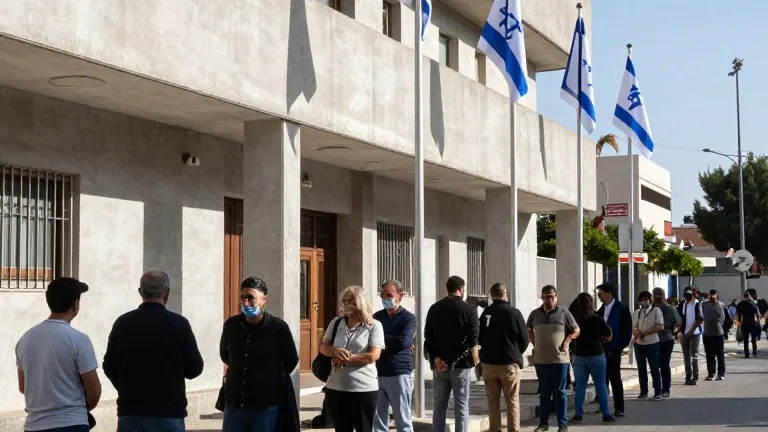
Israelis go to the polls Tuesday.
This is the first national vote since the Hamas-led attacks of October 7, 2023. The results will determine the direction of a government managing long-running conflicts, international criticism, and deep domestic division.
Two main coalitions compete for control. Prime Minister Benjamin Netanyahu leads a pro-government bloc that includes Likud, far-right parties, and ultra-Orthodox groups. This alliance features United Torah Judaism, Shas, Otzma Yehudi, and Religious Zionism-Zehut. Leaders Itamar Ben-Gvir and Bezalel Smotrich head the latter group.
The opposition fields a four-party Jewish-led coalition. It includes Gadi Eisenkot’s Yashar party, Yair Golan’s Democrats, Avigdor Lieberman’s Yisrael Beiteinu, and the Together alliance. Former Prime Minister Naftali Bennett and opposition leader Yair Lapid have joined the Together list. A party must win at least 3.25 percent of the vote to enter the 120-seat Knesset.
Final polls before the Friday publication ban indicated neither side would reach the 61 seats required for a majority. A KAN public broadcaster survey projected 52 seats for the opposition and 50 for Netanyahu’s bloc. The remaining seats likely go to unaffiliated groups, including the Arab-majority lists Ra’am and the Joint List.
Both major blocs have largely ruled out partnering with Arab-led parties. This stance could complicate coalition talks and increase the odds of a minority government or another election. Domestic issues drive voter anger. Many demand accountability for security failures prior to the 2023 attacks. Others oppose the ultra-Orthodox military exemption and Netanyahu’s judicial reform efforts.
Mairav Zonszein, a senior analyst at the International Crisis Group, stated that secular and liberal factions view this vote as the last chance to save Israeli democracy. International standing has also affected the campaign. Several allies sanctioned settlements in the occupied West Bank. Many nations condemned continued attacks in Gaza and Lebanon. Dozens of envoys walked out when Netanyahu addressed the UN General Assembly on September 24.
The stakes are personal for Netanyahu, who has led the country for more than 15 of the last 17 years. He faces scrutiny over pre-attack security lapses and corruption charges filed in 2019. A loss would expose him more in his ongoing trial, which could result in prison if convicted. A new government might also influence the inquiry into the 2023 attacks. An International Criminal Court arrest warrant for war crimes remains against him.
About 7.3 million citizens are eligible to vote, including roughly 1.2 million Palestinian citizens of Israel. Polls suggest turnout in that community could reach 60 percent. At that rate, Arab parties might secure up to 15 seats. Campaigners aim for 70 percent turnout, a high mark for recent decades. The Central Elections Committee barred the Joint List and Ra’am last month, but the Supreme Court reversed that decision. The court did remove Balad leader Sami Abu Shehadeh over an article describing the October 7 attacks as an important historical event.
Netanyahu argues his rivals will partner with Arab parties if they win. He claims only Likud can prevent that alliance. Joseph Mansour, a former aide to Knesset member Ayman Odeh, said this strategy could keep Netanyahu in office as a caretaker if no bloc secures a majority. Meanwhile, roughly three million adult Palestinians in Gaza, the West Bank, and East Jerusalem have no vote in the government controlling their borders and legal status.
Source: Al Jazeera